Google AI Overviews now appear at the top of search results, answering questions before users see a single link. Getting cited in AI is quickly becoming one of the most important goals in digital marketing. Gartner predicts traditional search volume will drop 25% in 2026 as people shift to AI-powered tools for answers. Visibility in AI is no longer a bonus it is truly where search is heading. A SearchEngineLand study of nearly 8,000 real citations shows exactly what earns those citations, and why most business websites never appear in them.
Why Traditional SEO Tactics Are No Longer Enough
These tactics are designed around one goal: earning a spot in the top 10 organic results. SEO optimizes for top keyword placements, backlinks, and technical signals that search engines have rewarded for many years. Models like ChatGPT and Google AI Mode work on a completely different logic (see RAG). They evaluate authoritative knowledge bases by referencing external data, before generating responses. Unlike Google’s search algorithm that looks at semantic meaning meaning or keyword density of single web pages. A page can rank on page one of Google and still be invisible inside AI-generated answers because ranking and being cited in the Ai overviews are two separate things.
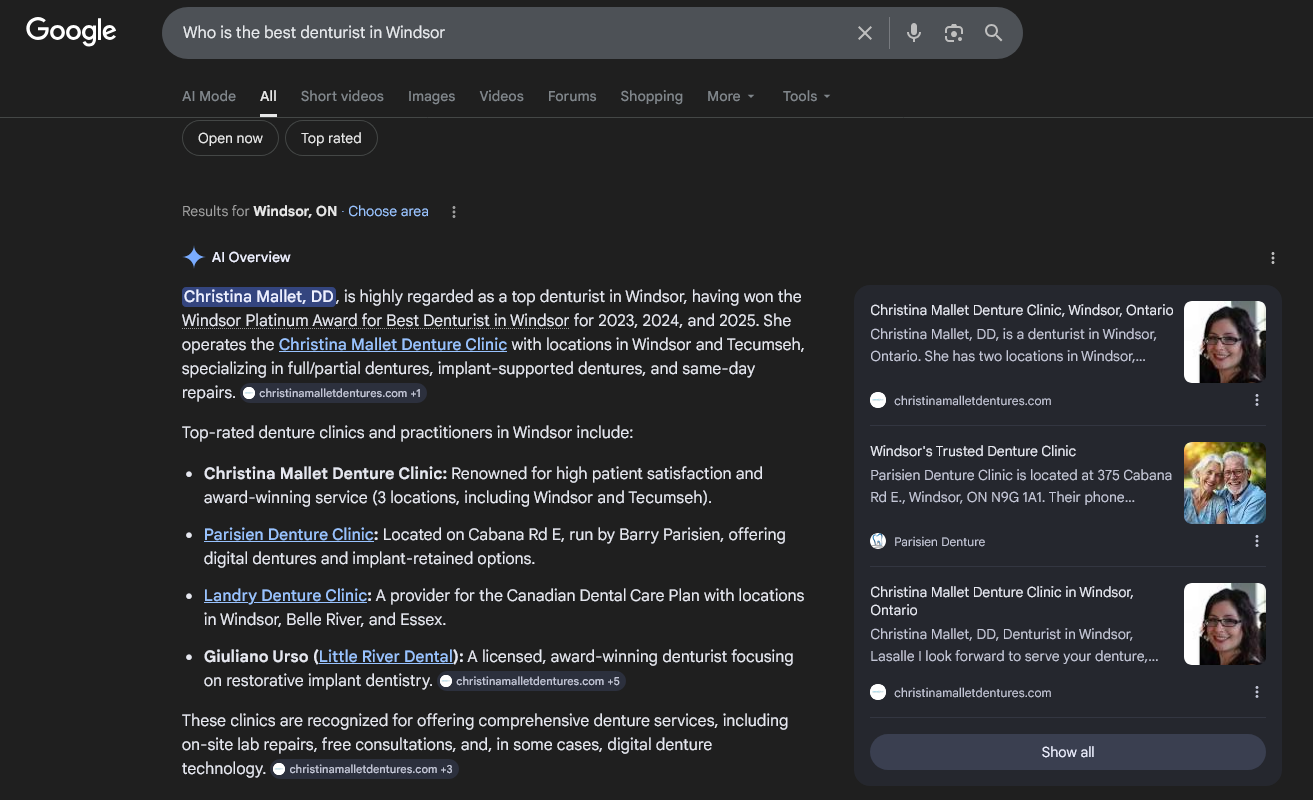
As you can see, the AI Overview for “Who is the best denturist in Windsor?” clearly features Christina Mallet DD. as a top choice. She and her website [https://christinamalletdentures.com/] are referenced multiple times throughout the AI summary and appear twice in the list of cited sources on the left.
The summary also highlights that Christina has won multiple awards as “Windsor’s best denturist”, supported by glowing patient feedback for patient care. Google also demonstrates a clear understanding of her website’s structure, listing her main services directly as ‘site links’ for what she offers.
Research shows that AI models pull from Wikipedia for 27% of ChatGPT citations. Reddit is even more dominant, appearing in 97.5% of product review queries within Google’s Discussions and Forums section, triggered mainly by searches like “best CRM for a 5-person team.” Since the Google made a $60 million deal with Reddit… Reddit’s visibility has skyrocketed, climbing from the 7th most visible domain in US Google search to the 2nd.
Meanwhile, vendor websites and product pages account for less than 3% of all cited sources across major platforms, while independent blogs and news outlets hold nearly half of all citations. These sources still earn citations because they’re informative and neutral not because they rank highly. A business that only optimizes for traditional rankings is missing the new game entirely.
What AI Engines Look For Before Citing a Page
Before an AI engine cites a page, it checks three things: how clearly the page answers a question, how thoroughly it covers the topic, and how much external credibility backs it up. Each factor is within your control.
So a simple Ai optimization road map here is:
- Find Questions that trigger Ai Overviews
- Answer that Question in Depth on your Website
- Back it up, with EEAT (Expertise, Experience, Authority and Trust)
You might be asking how do I demonstrate EEAT…. well, Remember that Ai overview of the denturist?
- Positive Client Reviews on Google & 3rd Party Websites
- Showcase all of your Awards and Excellence on About pages
- Site links – Good Technical & On-Page SEO is still important
- Schema Markup – Can help Google’s Understanding of a Website
- LLM.txt files – This can help Ai bots read your website content
- Authority – Press Releases, News, Content Publishing, Case Studies
All of these items help LLM’s come to a conciseness about to trust your Brand or not, and they are clear winners on who does this well online. They help users find information faster in Google.
Start With an Answer Capsule
Being cited by LLMs comes down to one simple habit: put your answer at the top of the page. Researchers call this an “answer capsule” — a short, self-contained response of 120 to 150 characters placed directly after a question-based heading. Structuring content for LLM retrieval this way is the strongest on-page citation signal in the dataset. Pages that open with a direct answer are 67% more likely to be cited than pages that take a slow build-up to their main point.
This format helps AI systems match your content to a user query in seconds. It also improves your chances of being cited by ChatGPT or surfaced in Google AI Mode — without requiring any technical changes to your website.
Back Your Content With Original Data
Pages with original data tables earn 4.1 times more AI citations than pages without them. Google AI Mode sessions consistently favor pages that contain unique data no other source can replicate. The strongest content pattern in the study — an answer capsule combined with original research or owned insight — appeared in 34.3% of all cited posts and produced the highest citation rates of any format tested.
AI overview’s evaluation does not stop at matching keywords to a query. It rewards pages that explain a topic through definitions, comparisons, examples, and data. That level of depth tells the language model your page is a credible, primary source — not a surface-level summary of what others have already written.
Use Structure and Freshness to Your Advantage
Clear H2 and H3 headings make pages 40% more likely to earn a citation. FAQ schema markup increases citation rates by 28% because it shows AI exactly where the questions and answers are on your page. Content updated within the past 30 days earns 3.2 times more citations than stale pages. You can use Google Search Console to see which of your pages appear in AI Overviews and other AI-generated results — giving you a clear picture of what is working and what needs attention.
The Off-Page Signals That Build AI Authority
Good on-page content is a starting point, not a finish line. AI engines check external signals before they trust and cite any source. The brands that appear most often in AI-generated answers have built a consistent, credible presence across the web — not just on their own website.
Build Brand Mentions That AI Engines Trust
AI assistants learn which brands are credible by reading content from Reddit, Quora, LinkedIn Posts, YouTube, industry blogs, and review platforms. When your business appears consistently across these sources in connection with your services, AI engines start treating you as an authority on those topics. For local businesses, this means Google reviews, local news coverage, and industry directory listings all play a role. Every mention from a credible source adds weight to your citation profile.
Go Deep on Topics to Capture Fan-Out Queries
When someone types a query into AI search, the system internally generates a set of related sub-questions called fan-out queries. alongside the main search. Research found that ranking in the top 10 for these related queries makes a page 161% more likely to earn citations than ranking for the main query alone. Pages covering both the primary topic and its related sub-questions account for 51% of all AI Overview citations in the study.
Ai Opportunity and Measurement Tools:
Google Ai citation analysis – Chrome Extension:
A chrome extension for SEOs to analyze and compare links in Google’s AI Overview and AI Mode sections with traditional SERP results.
BlogStorm – People Also Ask Tool:
Extract and organize People Also Ask questions from Google search results for better content research
XOFU – By Citation Labs:
Comprehensive analytics and insights to dominate AI-generated recommendations
ChatBeat:
Track your brand’s exposure across major AI platforms. We also recommend Brand24 for measuring your brand’s visibility in social.
Websites that perform well in AI Overviews, use pages that explore a topic from multiple angles rather than covering it in a single pass. A business that publishes comprehensive, multi-part content gives AI engines many more opportunities to find and cite its pages.
A Three-Track Plan to Optimize for AI
AI optimization does not mean starting over. It means adjusting your content strategy to meet three clear standards that AI engines consistently reward.
Make every website page easy to cite:
- Start articles with a direct answer to a question found in AI overviews
- Add H2-H3 sections with other supporting questions around a topic
- Add a FAQ page to your website with FAQ schema to address multiple questions about your company
- Update high-traffic pages regularly to stay within the freshness window
Build authority through Content depth:
- Identify the 8 to 10 core topics your business owns (Use a topical authority map)
- Write comprehensive content that covers the main topic and its most common sub-questions
- Connect related articles with descriptive internal links (Reverse content silo)
Build credibility back into your website:
- Answer questions in relevant online communities and local forums (Reddit, Quora, Industry Forums)
- Earn mentions in local news outlets, directories, and review platforms (PR, Reputation Management, Brand Equity)
- Publish original research or data that other sources will naturally reference (Data Reports, Case studies, White Papers)
Why Windsor-Essex Businesses Should Move Now
Among B2B buyers, 84% now use AI for vendor discovery and 68% open AI tools before they ever reach Google. AI traffic is growing steadily as a discovery channel while traditional click-through rates from organic search continue to fall. Tools like ChatGPT, Perplexity, and AI Mode have already changed how people find local businesses — including businesses in Windsor-Essex.
Most local service businesses here have not yet structured their content for AI citation. That is a gap your business can close before competitors do. The businesses that act now will hold a real advantage as more customers shift their search habits toward AI-generated answers.
Get Found in Google’s AI Overviews Before Your Competitors Do
Google’s AI Overviews reward businesses that answer questions clearly, use original data, and earn credibility across the web. The same strategies that improve AI citation visibility also strengthen traditional SEO results — these are not two separate approaches. They reinforce each other. What has changed is the order of priority: clear answers, solid structure, and verified authority now determine who appears in AI-generated results at the top of modern search.
SEOBANK Digital Marketing Agency helps businesses across Windsor-Essex County build the content strategy and authority signals needed to earn AI citations and grow their online visibility. If your business is not appearing in AI-generated answers, contact Chris today at 519-890-3979 or book a free strategy consultation.