
Search is changing. Results now do two jobs. They still rank pages in a list of links, and they also show AI-written answers that name a few businesses. Winning at SEO and AEO 2026 means earning both a strong organic position and a mention inside the answer. SEOBANK Digital Marketing Agency, a Google-certified team in Kingsville, Ontario, builds websites and local profiles that grow visibility across search results, maps and AI answers for Windsor-Essex businesses. This guide numbers the 10 ranking factors still working in 2026, then explains how SEO and AEO work together and how to measure progress.
Ranking Signals That Still Move Organic Results
Ten ranking factors still move organic results in 2026: intent-matched content, E-E-A-T, site speed and crawlability, on-page structure, topical authority, entities, information gain, real engagement, internal links and brand authority. AI answers pull from the same pages that win these factors.
Google states that a page only needs to be indexed and eligible for a search snippet to appear as a supporting link in AI Overviews or AI Mode. Its guidance on AI features adds that no special optimization is required. That is the core of SEO and AEO 2026: the factors below power your organic rankings and your AI citations at the same time. The table gives the short version, and each section explains what to do first.
| # | Ranking Factor | What It Proves to Search and AI Systems | First Move |
|---|---|---|---|
| 1 | In-Depth Content That Matches Search Intent | The page fully answers the goal behind the query | Map one main question to each page |
| 2 | Experience, Expertise, Authority and Trust | A real, qualified business stands behind the page | Add named authors, credentials and project proof |
| 3 | Site Speed & Crawl Optimization | Bots can reach, render and index every important page | Pass Core Web Vitals and fix crawl errors |
| 4 | On-Page: Zone Theory and HTML Structure | The page declares who, what and where in high-weight zones | Write a page declaration right under the H1 |
| 5 | Topical Authority and Reverse Silos | The site covers one subject in depth | Publish supporting posts that link up to the service page |
| 6 | Entity & Semantic SEO | Search engines can identify the business as one distinct entity | Align schema, Business Profile and social profiles |
| 7 | Information Gain | The page adds something new beyond what already ranks | Publish original data, photos and comparisons |
| 8 | Real Engagement, CTR and Rank Boost | Searchers choose the page and stop searching | Rewrite titles and meta descriptions to earn the click |
| 9 | Internal Link Graph | Authority and context flow to priority pages | Fix orphan pages and use descriptive anchor text |
| 10 | Backlinks & Brand PR | Other websites vouch for and mention the brand | Earn local links and press mentions |
1. In-Depth Content That Matches Search Intent
In-depth content that matches search intent answers the exact goal behind a search, in the format searchers expect, so completely that they do not return to the results page. Depth means covering every subtopic a buyer needs, not adding word count.
Search intent is the goal behind a query: to learn, compare, buy or find a specific business. Google ranks the page type that best serves that goal. If the top results for “water heater installation Windsor” are all service pages, a blog post will struggle to reach page one.
Each page should answer one main question completely. A service page explains what the service includes, who it suits, how the process works and what to do next. A blog post answers a research question and links to the matching service page. Pages that leave obvious questions unanswered send searchers back to the results, and that behaviour feeds the engagement signals covered in factor 8.
How SEOBANK Builds Intent-Matched Pages
Before writing, our team checks which page types rank for the target query today, then builds one page per main question, covering cost, process, timing, service area and next steps in the order a buyer asks them.
Strong city pages describe real work done in that community. They do not reuse template text with a new town name. Our guide to dominating local map packs and our local SEO services explain this approach in more detail.
2. Experience, Expertise, Authority and Trust
E-E-A-T stands for experience, expertise, authoritativeness and trust. Google’s quality raters use it to judge whether content comes from a credible source, and Google’s rater guidelines call trust the most important part. Pages show it with named authors, credentials, real project proof and accurate business details.
Every page we build shows proof of real experience. SEOBANK’s team adds project photos, named authors, service details and credentials where they apply. Author bios link to verifiable profiles. Chris, Lead SEO at SEOBANK, links his author profile to his ORCID record and LinkedIn page, so search engines can connect the writer to his body of work. To see how the search engine describes E-E-A-T, review its published search quality rater guidelines.
How SEOBANK Responds to Core Updates
When a core update rolls out, we read the search engine’s status dashboard and its documentation for site owners, then audit client pages against that guidance before changing anything.
Every page we build has four traits:
- Original content based on first-hand work, not rewrites of other websites
- Clear authorship, business details and service areas
- Fast, stable pages that work well on phones
- One dedicated page for each core service and each city served
Our Policy on Mass-Produced AI Content
Our team does not publish bulk AI-written pages for clients. A person who knows the trade edits every page before it goes live.
Every client we work with has their own brand project. Inside it, the AI works from that client’s ideal customer profile (ICP), customer pain points, tone of voice, E-E-A-T factors and general business information. That context is why a page for a denture clinic reads nothing like a page for a greenhouse builder, even when both target the same city.
We usually combine traditional human writing with a layer of AI-enabled workflows for the best SEO optimization. Each side does the job it does best:
- Human writers shape the angle, the story and the first-hand detail
- AI-enabled workflows handle the SEO layer: entity coverage, People Also Ask and fan-out questions, internal links and on-page structure
- A person who knows the trade edits every page before it goes live
The result sounds like the business, carries real E-E-A-T signals and still hits every on-page target. That is the opposite of what Google’s spam policies target. Google added a “scaled content abuse” rule in March 2024. It targets pages produced at volume mainly to manipulate rankings, whether a person or an AI wrote them. Google’s guidance on AI-generated content rewards quality and helpfulness, however the content was made. If you plan to publish AI-assisted content at volume, read the search engine’s spam policies first.
3. Site Speed & Crawl Optimization
Site speed and crawl optimization make sure search engines and AI crawlers can reach, render and index every important page quickly. A page that is slow, blocked or hidden behind scripts cannot rank in organic results, and it cannot be cited in an AI answer either.
Crawlability and Crawl Budget
Crawlability is how easily a bot can find and read your pages. Crawl budget is how many pages a search engine is willing to crawl on your site in a given period, so wasted crawls on broken or duplicate URLs delay your important pages.
Search systems and AI crawlers must reach every important page. Our audits find broken links, blocked pages, duplicate content and missing sitemaps. Fixing them makes each page easier for search engines to crawl. We also confirm that the robots.txt file, the hosting firewall and the CDN allow the bots you want, including Googlebot, Bingbot, GPTBot from OpenAI, ClaudeBot from Anthropic and PerplexityBot. Security plugins and bot rules can block these crawlers without anyone noticing, so check your server logs.
Keep important content in plain HTML text, not inside images or scripts. Google lists this among its best practices for AI features. Microsoft’s Bing team also says generative AI favours fresh content and recommends the IndexNow protocol to push page updates instantly.
Mobile Performance and Core Web Vitals
Core Web Vitals are Google’s page experience metrics. A page passes when Largest Contentful Paint is 2.5 seconds or less, Interaction to Next Paint is 200 milliseconds or less and Cumulative Layout Shift is 0.1 or less, measured on real visits.
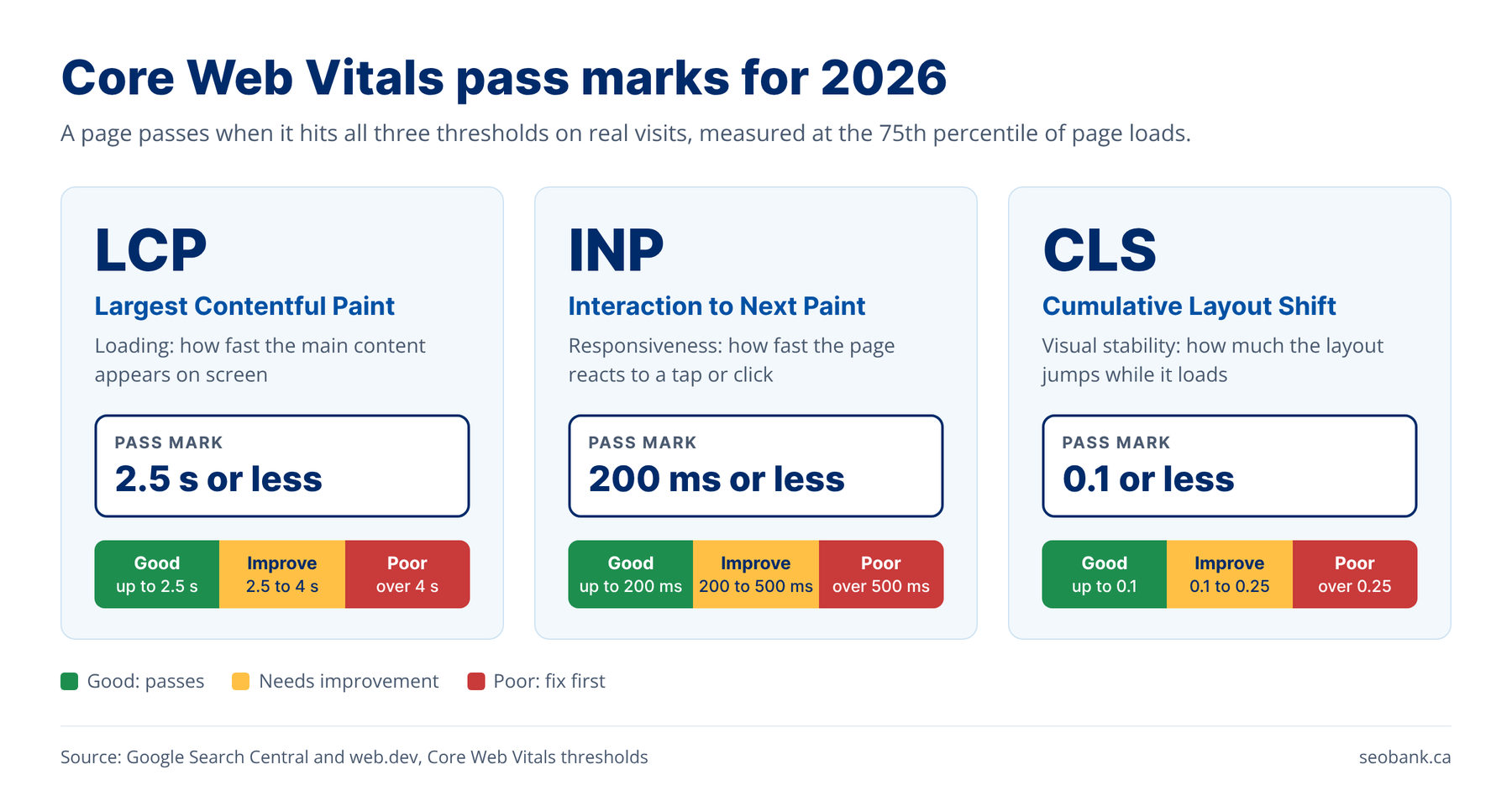
We compress images, remove slow scripts and test layouts on small screens. These fixes help pages load fast on phones, where most local searches happen. If your theme or page builder is the bottleneck, our web development team rebuilds templates for speed instead of stacking more plugins on top.
Before and After: Speeding Up Our Own Website
We tested our own website in GTmetrix before and after an optimization pass. Performance rose from 59% to 98%, the grade moved from C to A, and Largest Contentful Paint dropped from 4.4 seconds to 885 milliseconds, about 80% faster.
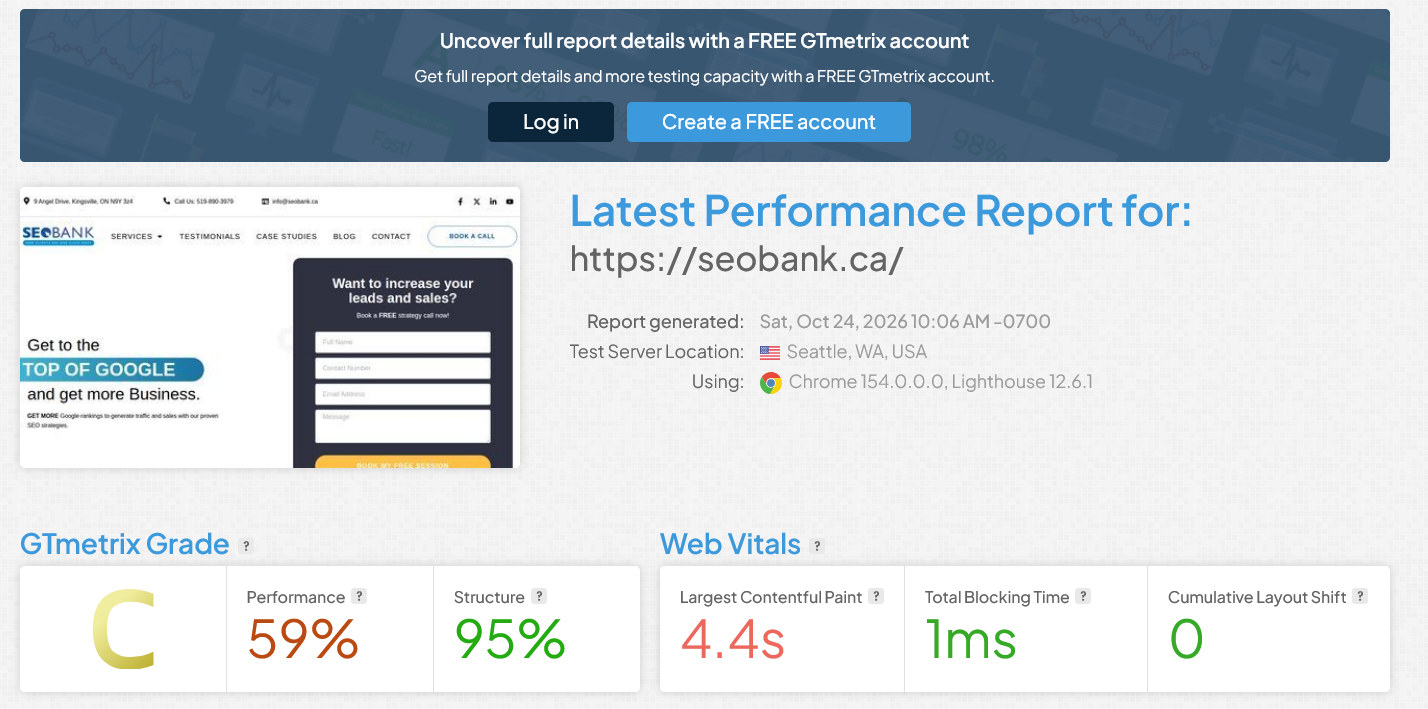
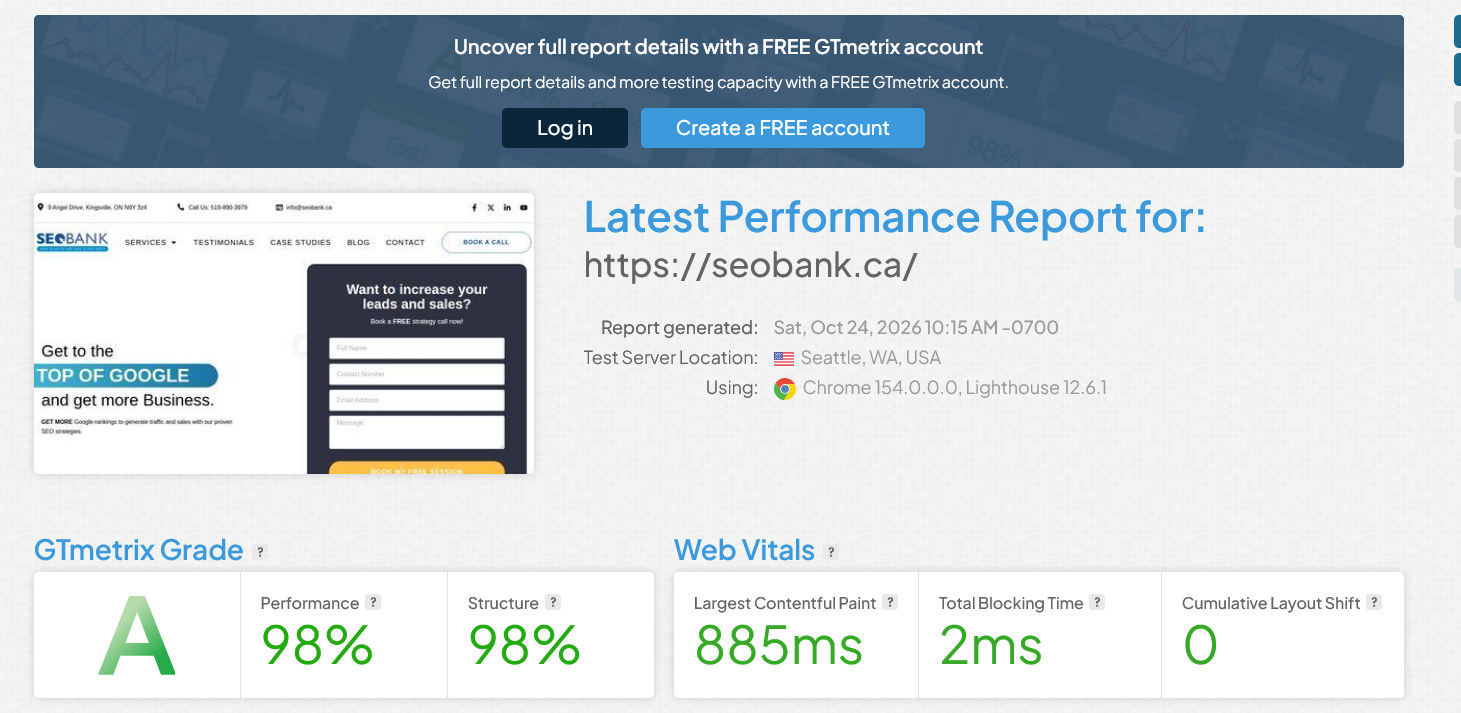
Both tests of seobank.ca ran on October 24, 2026 from GTmetrix’s Seattle test server, using Lighthouse 12.6.1 in Chrome. Total Blocking Time stayed near zero and Cumulative Layout Shift stayed at 0, so the gain came from how fast the main content loads.
Site speed is not a one-time fix. Every new plugin, oversized image, embedded video, theme or page builder update and tracking script adds weight, and a fast site can slow down without anyone noticing. Check your speed at least once a quarter, and re-optimize when the scores slip.
When to re-test site speed:
- Every quarter, even when nothing seems wrong
- After installing or updating plugins
- After adding large images, sliders or embedded videos
- After theme, page builder or WordPress updates
- After adding chat widgets, ad pixels or other third-party scripts
Run the same test each time so the numbers compare fairly. GTmetrix and Google PageSpeed Insights are both free, and PageSpeed Insights also shows field data from real Chrome users when your site has enough traffic.
4. On-Page: Zone Theory and HTML Structure for SEO
Zone Theory is an on-page framework. It treats every page as a series of zones that search engines weight differently, then places the strongest signals (who you are, what you do and where you do it) in the highest-weight zones near the top of the HTML.
The idea comes from information retrieval. BM25F is a field-weighted version of the BM25 ranking formula, taught in Stanford’s information retrieval course by Christopher Manning and Google’s Pandu Nayak. It scores a word by where it appears, so a term in the title, H1 or opening paragraph outweighs the same term in the footer. Repetition saturates, so stuffing a keyword adds little. Zone Theory turns that math into a page layout. SEOBANK’s strategy here is to state who, what and where in the first three zones, then prove it in every section below.
The 8 Zones of a Page
Every important page has eight zones, from the header down to the footer. The first three zones decide how fast Google identifies the page, so they carry the brand, service and location signals.
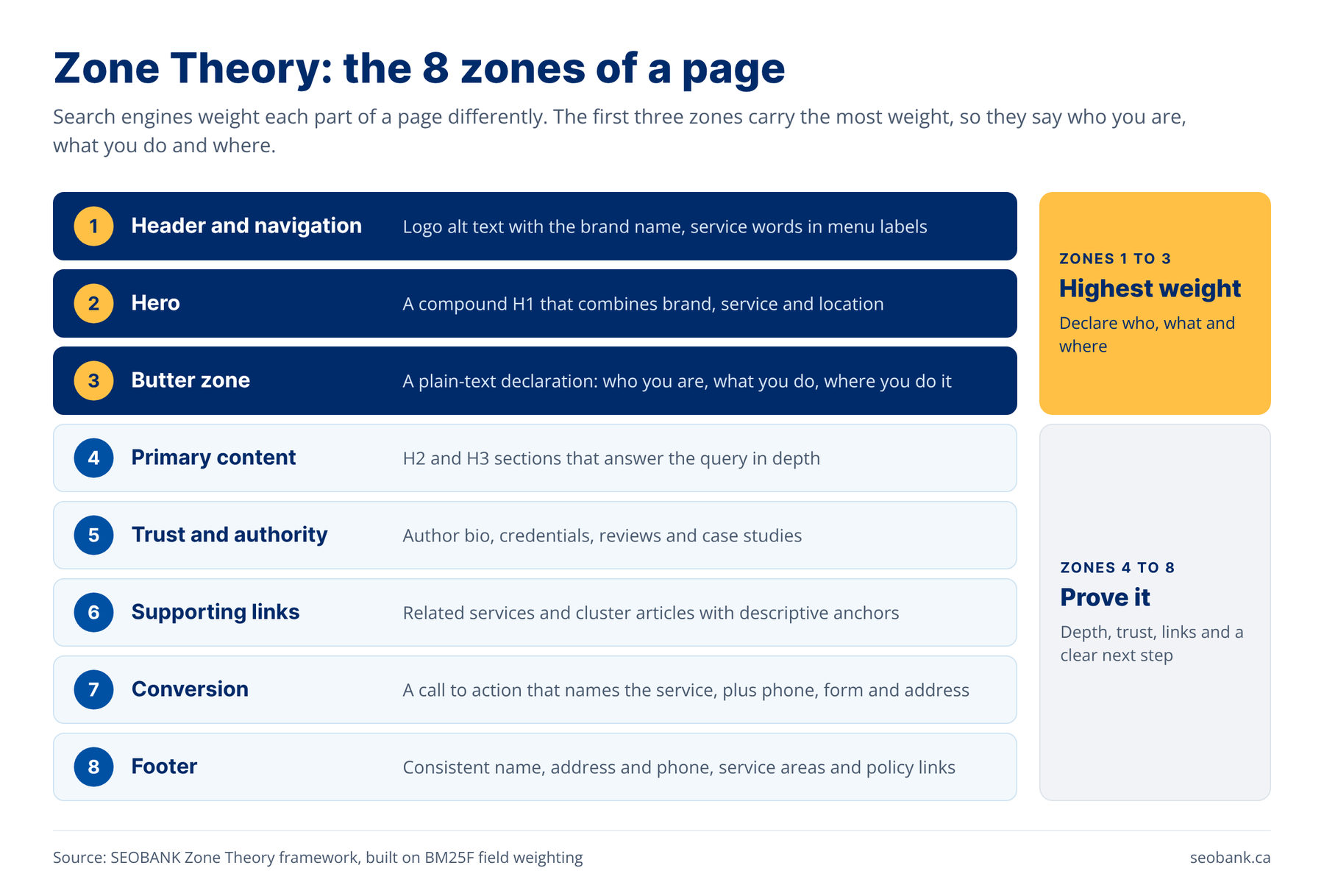
| Zone | Name | What Goes There |
|---|---|---|
| 1 | Header and Navigation | Logo alt text with the brand name, service words in menu labels |
| 2 | Hero | A compound H1 that combines brand, service and location |
| 3 | Butter Zone | A plain-text page declaration: who you are, what you do, where you do it |
| 4 | Primary Content | H2 and H3 sections that answer the query in depth |
| 5 | Trust and Authority | Author bio, credentials, reviews and case studies |
| 6 | Supporting Links | Related services and cluster articles with descriptive anchors |
| 7 | Conversion | A call to action that names the service, plus phone, form and address |
| 8 | Footer | Consistent name, address and phone, service areas and policy links |
The Page Declaration Formula
The page declaration is one plain paragraph under the H1 that states: [Company] is a [service provider] in [location], providing [service 1], [service 2] and [service 3]. It hands Google a clear entity statement before the detailed sections begin.
For example: “Smith Plumbing is a residential plumbing company in Windsor, Ontario, providing water heater installation, drain repair and emergency plumbing across Essex County.” On location pages, the sentence stays the same and only the city changes. The opening paragraph of this article follows the same pattern for SEOBANK Digital Marketing Agency.
HTML Structure Rules We Follow
Clean HTML makes each zone easy to parse. Use one H1, keep headings in order from H2 to H3 to H4 without skipping levels, and put key facts in real text that both people and machines can read.
- Write title tags as “Target Keyword | Benefit or Searcher’s Goal | Brand Name”
- Use semantic HTML elements such as header, nav, main, article and footer
- Give every image a descriptive file name and alt text
- Keep paragraphs short, with one idea each
Our on-page SEO checklist for 2026 covers 15 more page-level factors, and our on-page SEO service applies Zone Theory to every page we optimize.
5. Topical Authority and Reverse Silos
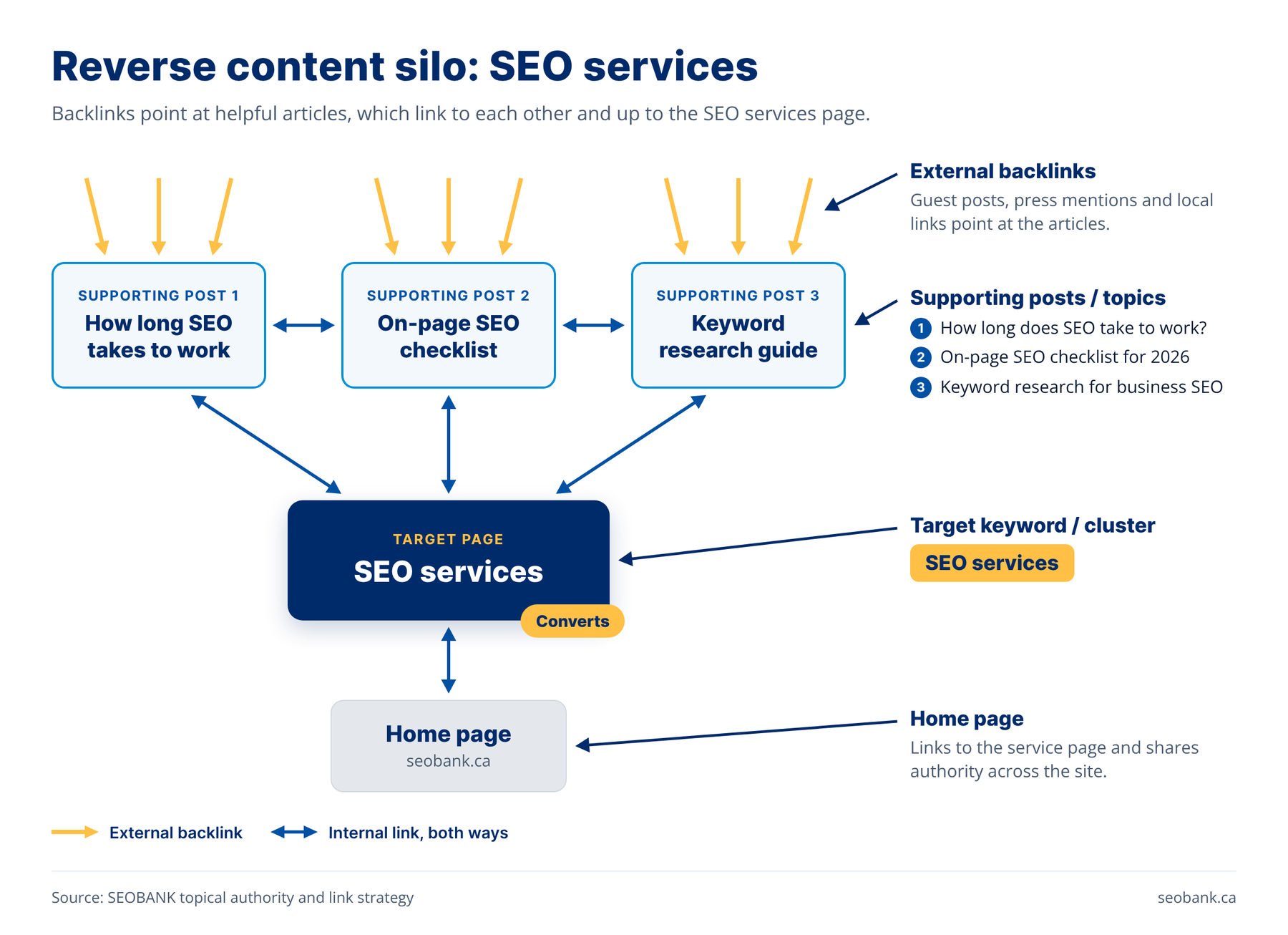
Topical authority is the depth of coverage a site shows on one subject. A reverse silo builds it: supporting articles each link up to one money page, and outside links point at those supporting articles, so authority flows up to the page that converts.
Topic clusters link several related articles to one service page, which shows depth on that subject. A classic silo sends backlinks straight to the money page. A reverse silo flips that order. Other websites rarely link to a sales page, but they do link to a helpful guide or cost breakdown. When those guides link up to the service page, it gains authority without an unnatural pile of commercial anchors.
How to Build a Reverse Silo
Pick one money page, publish four to eight supporting articles on the questions buyers ask before they hire, link each article up to the money page and to its sibling articles, then point outreach and PR at the supporting articles.
- Choose the money page, such as a service page that converts.
- List the research questions buyers ask before they hire for that service.
- Publish one supporting article per question.
- Link every supporting article up to the money page and across to related articles.
- Direct guest posts, press mentions and local links at the supporting articles.
Our SEO packages include topic clusters and reverse silos as standard.
6. Entity & Semantic SEO
Entity SEO helps search engines recognize your business as one distinct thing, with a name, location, services, people and relationships, rather than a string of keywords. Semantic SEO covers the related concepts a topic needs, so systems understand the full meaning of each page.
An entity is a uniquely identifiable person, place, organization or concept. Google stores entities and their relationships in its Knowledge Graph, and AI systems resolve names to entities before they answer. Conflicting details make a system doubt you or confuse you with a similar business. Matching details let it describe you with confidence. Our article on the impact of Google entities in SEO covers the theory behind this.
Your Business Profile Is an Entity Record
Your Google Business Profile is one of the strongest entity records Google holds about a local business, so every field should be complete and accurate.
Our team handles five profile tasks for local clients:
- Set the most accurate primary category
- List every service and product
- Post updates and photos each month
- Keep hours accurate, including holidays
- Reply to every review
The search engine’s help centre explains how it ranks local results. Read it before you change a category.
Consistent Business Details Everywhere
Your business name, address and phone number should match everywhere: your website, business profile, directories, social profiles and schema markup.
Add sameAs links in your Organization schema that point to your official profiles. Those links tell machines that the profiles and the website describe the same entity. Check each platform’s guidelines for how to list your business.
7. Information Gain
Information gain is the new information a page adds beyond what a searcher has already seen. Pages that repeat the current top results give search and AI systems no reason to rank or cite them. Original data, photos and first-hand detail change that.
Google holds a patent called “Contextual Estimation of Link Information Gain” (US12013887B2), filed in 2018 and granted in June 2024, as Search Engine Journal reported. It describes scoring documents by how much new information they add compared with documents a user has already viewed. Google has not confirmed that it uses the patent in Search. The logic still fits how AI answers choose sources. A model gains little from quoting a fifth copy of the same advice, so it reaches for the page that adds a number, a comparison or a detail nobody else published.
Ways to Add Information Gain
The fastest information gain comes from what only your business knows: real prices, real timelines, real photos and real results from jobs you completed.
- Publish price ranges from completed jobs
- Show before-and-after project photos with captions
- Share results data from your own campaigns or installs
- Quote your technicians or owners on common mistakes
Build Comparisons for Buying Questions
Comparison content, such as tank versus tankless or repair versus replacement, sets the options side by side in one clear passage that search engines and AI tools can lift as a complete answer.
Add a table when the comparison has more than two attributes. Then state a plain recommendation for each type of buyer, so the reader leaves with a decision instead of a list of trade-offs.
8. Real Engagement, CTR and Rank Boost
Real engagement is how searchers respond to your listing and your page: whether they click, stay and stop searching. Google uses click data to adjust rankings, so earning more real clicks and satisfied visits gives a rank boost to pages that already sit on page one.
Google’s click system is called NavBoost. In the 2023 U.S. antitrust trial against Google, Search executive Pandu Nayak testified that it has run since 2005 and uses about 13 months of user interaction data. Documents that surfaced in 2024 also refer to good clicks, bad clicks and “last longest clicks,” the result a searcher clicks last and stays on.
Clicks are also getting harder to earn. An Ahrefs study of 300,000 keywords, published in February 2026, found that position-one click-through rate on queries with an AI Overview was 58% lower than forecast without one. Each listing now has to work harder for its click.
How to Earn the Click
Your title tag and meta description are the ad for your page. Lead with the searcher’s goal, add a specific benefit and finish with your brand name.
Review stars on your Business Profile, a recognizable brand name and a title that matches the exact question all lift click-through rate. Our guide to improving your click-through rates covers testing titles and descriptions.
How to Keep the Visit
Put the answer above the fold, load fast and give one clear next step. A visitor who finds the answer and calls you will not go back to the results page.
Our website conversion optimization service tests layouts and calls to action so more of those visits turn into calls and form fills.
9. Internal Link Graph
Your internal link graph is the network of links between pages on your own site. It tells search engines which pages matter most, how topics relate and where to send authority. Descriptive anchor text and short click paths to priority pages make it work.
Every link passes some authority and some context. A page with many relevant internal links pointing to it looks important. A page with none, called an orphan page, may not get crawled at all. Google lists internal linking among its best practices for appearing in AI features, because links are how crawlers discover and connect your content.
Internal Linking Rules We Follow
Every priority page should sit within three clicks of the homepage and receive links from related articles using anchor text that describes the destination.
- Link from high-traffic posts to the service pages that convert
- Use descriptive anchors such as “water heater repair in Windsor,” never “click here”
- Link sibling articles in the same topic cluster to each other
- Audit for orphan pages and broken internal links every quarter
Our guide to internal linking and SEO explains anchor text, link placement and authority flow in depth.
10. Backlinks & Brand PR
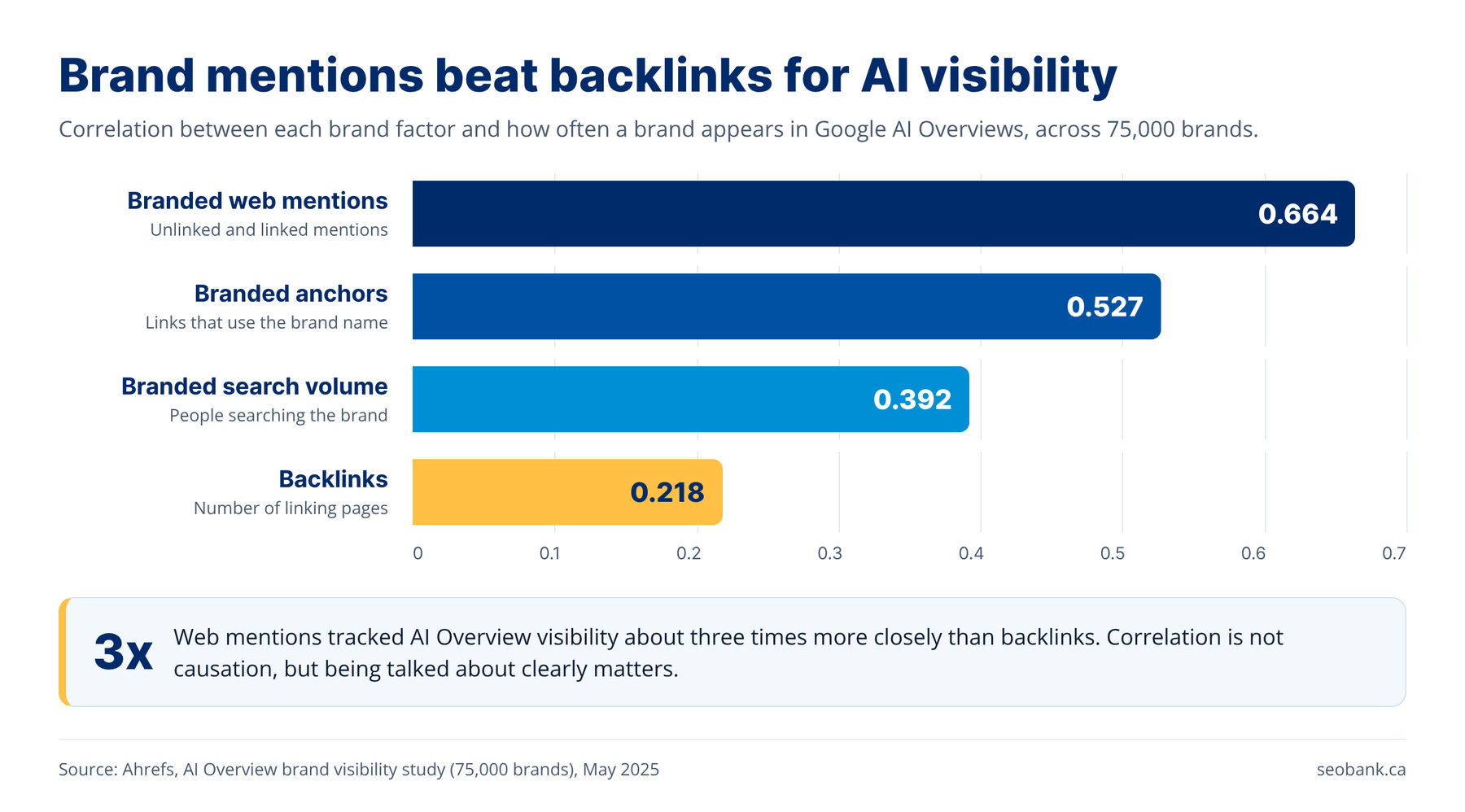
Backlinks and brand PR prove that other websites trust and talk about your business. Links still pass authority, but brand mentions now matter just as much for AI answers. In one study of 75,000 brands, web mentions tracked AI visibility three times more closely than backlinks.
That study, the Ahrefs analysis of AI Overview brand visibility from May 2025, found that branded web mentions had the strongest correlation with AI Overview appearances (0.664), ahead of branded anchors (0.527) and branded search volume (0.392). Backlinks scored 0.218. Correlation does not prove cause, but being talked about clearly matters as much as being linked to.
Local Links That Prove You Are Real
Links from local business associations, sponsorships and supplier pages show that your business is real, active and rooted in its community.
Our link building service focuses on relevant local and industry links, and our article on local link building strategies for contractors lists the easiest wins.
Brand Mentions on Trusted Websites
We pursue mentions in local news, chamber of commerce directories, supplier pages and event sponsorships. Each mention names your business, your services and your city.
Reviews and Community Discussions
Steady, recent reviews describe your services in your customers’ own words, and AI tools often quote review platforms when they recommend a business.
Before you start asking customers for reviews, read the review platform’s policies and Competition Bureau Canada’s guidance on online reviews.
Video With Transcripts and Chapters
Short local videos that answer customer questions give search engines and AI tools another trusted source that names your business.
For each video, we:
- Cover one question per video
- Upload a full transcript
- Add chapter markers
- Use a title that matches how customers search
How SEO and AEO 2026 Work Together
SEO earns your page a ranking. AEO, answer engine optimization, earns your business a citation inside AI answers from Google AI Overviews, AI Mode, ChatGPT, Gemini and Perplexity. Both run on one foundation: AI systems can only quote pages they can crawl, understand and trust.
SEO stands for search engine optimization. AEO stands for answer engine optimization. Traditional SEO focuses on ranking pages in search results. AEO focuses on getting your business cited by AI answer engines. Generative engine optimization (GEO) applies the same goal to generative AI platforms. The SEO vs AEO vs GEO labels differ, but the foundation stays the same. Strong SEO is the starting point for AEO, and the 10 factors above are that foundation.
Ranking in Results vs. Being Cited in Answers
A ranking in traditional search sends a click to your website. A citation puts your business name in front of a buyer inside the answer, sometimes with no click at all.
SEOBANK tracks phone calls, form fills and booked jobs, not just traffic from AI answers or search. A buyer can call you straight from an AI answer, so a citation can be worth as much as a top ranking even when your analytics show no visit.
From Short Keywords to Full Questions
People now type full questions and use voice search to ask them, so pages that answer real customer questions in plain language fit modern search better than pages built around one short keyword.
A buyer might ask, “Who installs tankless water heaters near Kingsville?” Each query reads like a conversation. Once the 10 ranking factors are in place, five AEO tactics turn those conversations into citations.
AEO Tactic 1: Schema Markup
Schema markup is structured data code that labels your business name, services, location, people and FAQs in a format machines read without guessing. Google requires it to match the visible page, and Microsoft’s Bing team says it helps its LLMs understand your content.
SEOBANK’s team adds local business, service and FAQ schema to client websites, as our local schema guide explains. Microsoft’s Fabrice Canel confirmed at SMX Munich in 2025 that schema helps Bing and Copilot’s language models understand pages, as Search Engine Land reported.
The core types for a local business site are Organization or LocalBusiness, Service, Person for each author, Article, BreadcrumbList and FAQPage. One caution: since August 2023, Google shows FAQ rich results mainly for well-known government and health websites. FAQPage markup still labels your answers for machines, so it stays useful for SEO and AEO 2026 even without the expandable snippet. Confirm current rich result rules in the search engine’s structured data documentation.
AEO Tactic 2: LLMs.txt Optimization
LLMs.txt is a Markdown file at your website’s root that gives AI tools a clean summary of your business and links to your most important pages. It will not rescue a weak page, but it hands AI agents an accurate, quotable fact sheet.
Jeremy Howard of Answer.AI proposed the format in 2024. Adoption grew quickly. Originality.ai tracked llms.txt files rising from 4,088 sites in June 2025 to 36,120 by May 2026, an 8.8 times increase, according to PPC Land’s coverage. The same report cites Ahrefs server-log data showing that 97% of those files received zero requests, and Google says you do not need new AI text files to appear in its AI features.
So why publish one? The file costs little, keeps your core facts in one place and gives AI agents that do fetch it a clean source. It is also the third layer of the Rule of 3 below. At SEOBANK, every llms.txt file we build lists services, service areas, proof points and contact details, linked to the pages with full detail. Our article What Is LLM.txt Optimization? walks through the file structure.
AEO Tactic 3: FAQs and PAAs Built From Fan-Out Queries
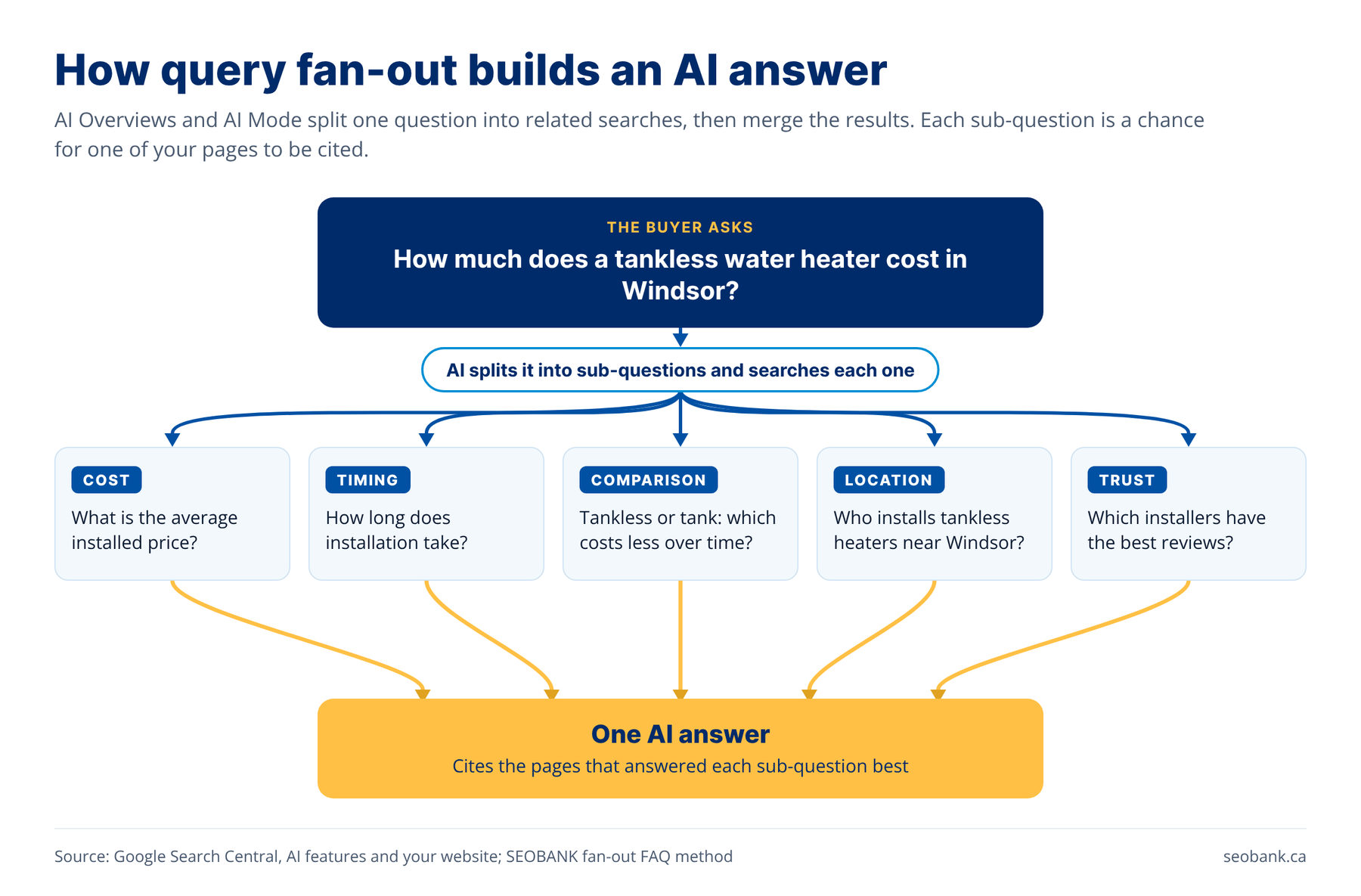
Query fan-out is how Google’s AI features answer a question: a language model splits it into related sub-questions, runs a search for each and merges the results. Pages that answer those sub-questions directly, in FAQ and People Also Ask format, give the system more passages to cite.
Robby Stein, Google’s VP of Product for Search, described the process in a 2025 interview reported by Search Engine Journal. For “things to do in Nashville with a group,” the model infers related needs, such as restaurants, bars and activities, then searches for each. Google’s documentation confirms that AI Overviews and AI Mode may both use this technique. People Also Ask (PAA), the expandable box of related questions in search results, previews many of those sub-questions.
How to Build a Fan-Out FAQ
- Write the main buyer question, such as “How much does a tankless water heater cost in Windsor?”
- Collect the PAA questions Google shows for it and for close variations.
- Ask the same question in AI Mode, ChatGPT and Perplexity, and note the subtopics each answer covers.
- Group the sub-questions by cost, timing, comparison, location and trust.
- Answer each one in 40 to 60 words directly under a question-style heading, then add detail below.
- Mark up the FAQ block with FAQPage schema that matches the visible text.
Our writers place a direct summary of 40 to 60 words under each main heading, with more detail below it. This house practice structures your content so AI systems can extract the answer to each question without guesswork. Our guide on how to get cited in AI Overviews and LLMs covers more detail.
AEO Tactic 4: The Rule of 3: Schema, Website and LLMs
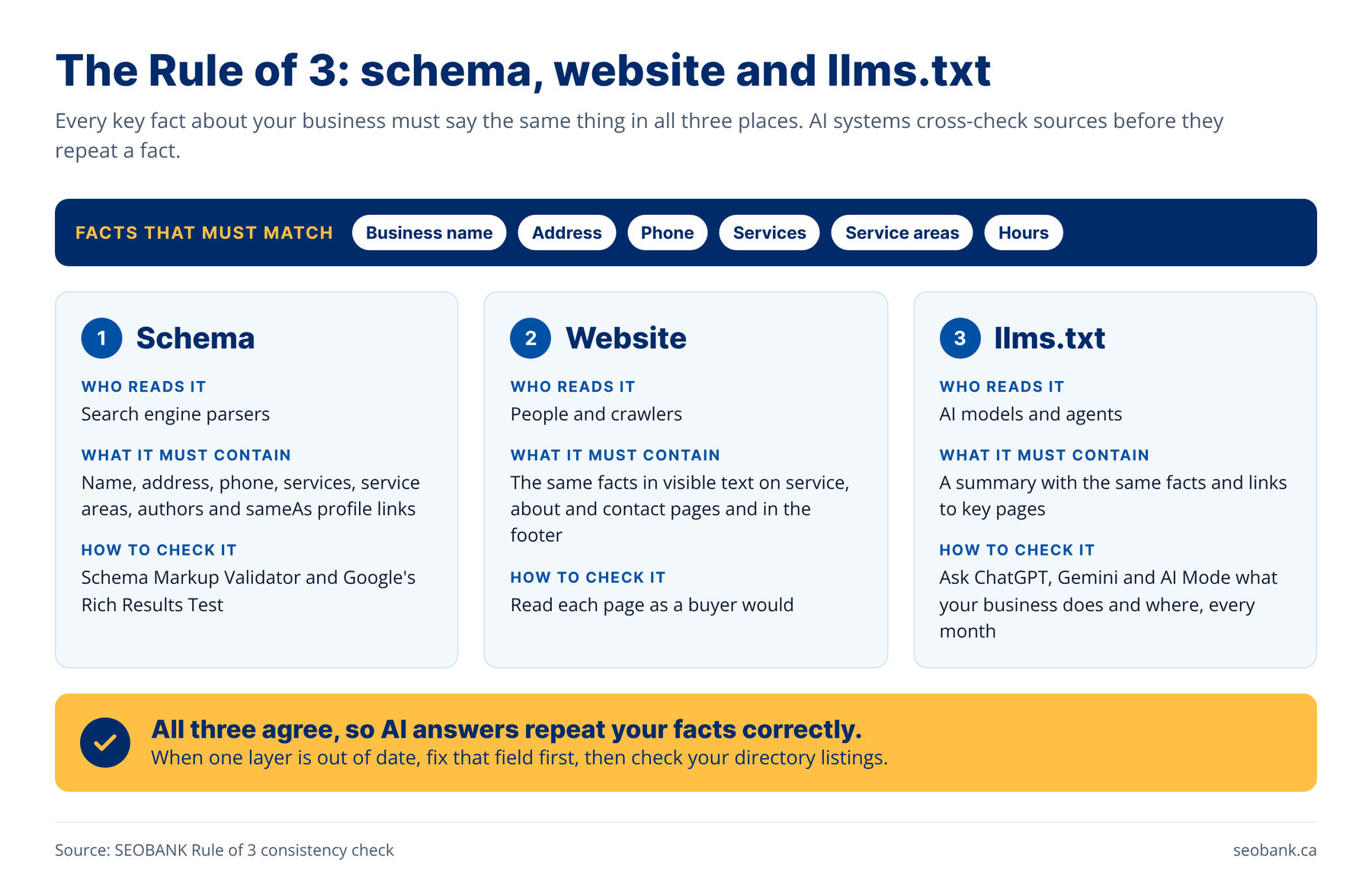
The Rule of 3 is a consistency check for AI search. Every key fact about your business must say the same thing in three places: your schema markup, your visible website and your llms.txt file. Then confirm that the AI models repeat it back correctly.
SEOBANK’s team relies on this check because AI systems cross-check sources before they repeat a fact. When your schema lists one phone number, your contact page lists another and your llms.txt file lists a third, the system has three conflicting answers and no reason to trust any of them. When all three layers agree, each one corroborates the others.
| Layer | Who Reads It | What It Must Contain | How to Check It |
|---|---|---|---|
| Schema | Search engine parsers | Business name, address, phone, services, service areas, authors and sameAs profile links | Schema Markup Validator and Google’s Rich Results Test |
| Website | People and crawlers | The same facts in visible text on service, about and contact pages and in the footer | Read each page as a buyer would |
| LLMs | AI models and agents | An llms.txt summary with the same facts and links to key pages | Ask ChatGPT, Gemini and AI Mode what your business does and where, every month |
When an AI answer gets your hours, services or service area wrong, check these three layers first, then your directory listings. The fix is usually a single outdated field.
AEO Tactic 5: Reverse-Engineer Your Competitors’ AI Citations
AI answers name the businesses whose details appear across the sources the model trusts. Ask an AI tool which sources it used for a competitor, list them, then earn a place on the same review sites, directories and business registries.
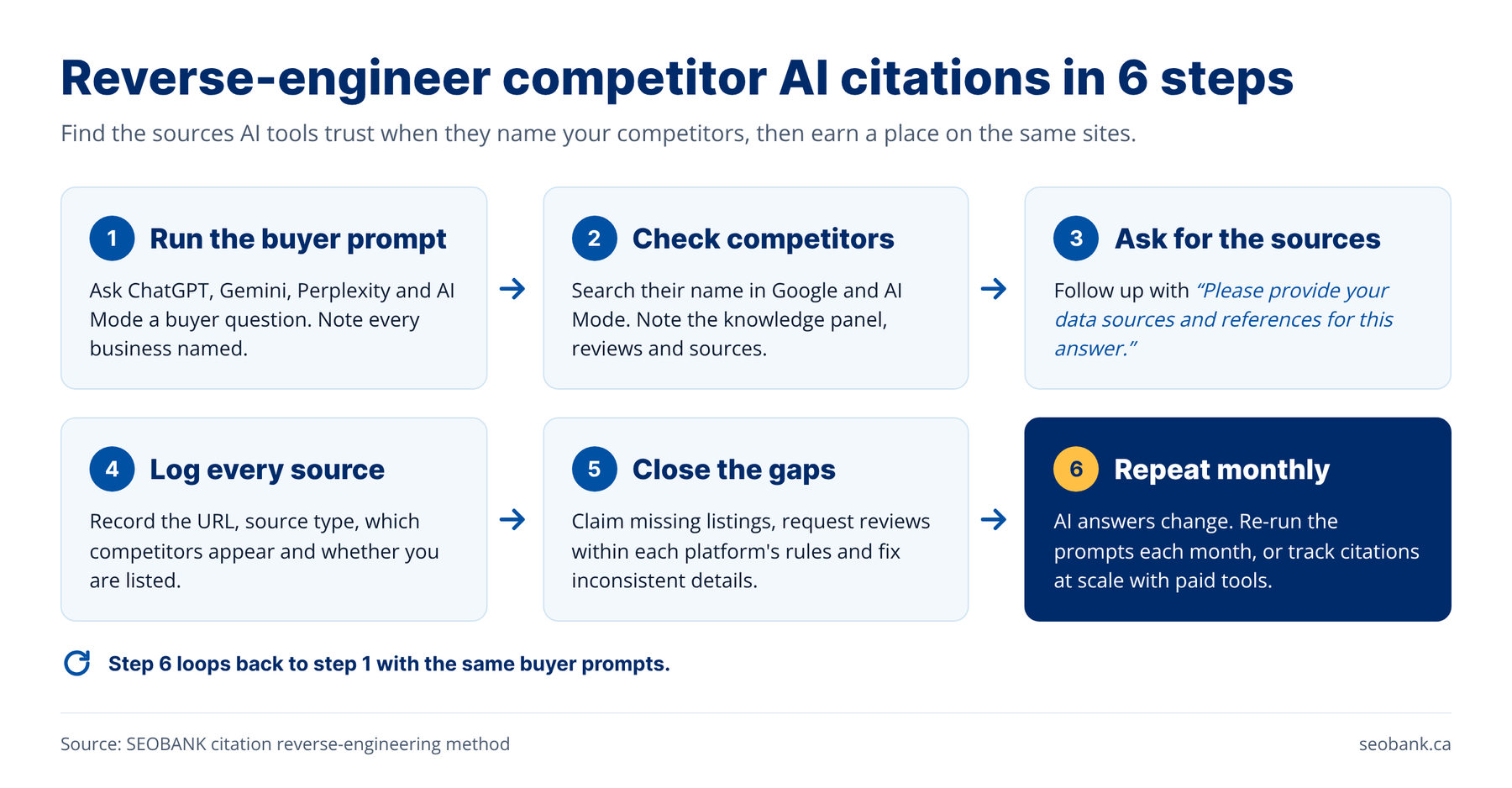
The 6-Step Citation Reverse-Engineering Method
- Run the buyer prompt. Ask ChatGPT, Gemini, Perplexity and Google AI Mode a buyer question, such as “best painting company in Windsor, Ontario.” Note every business named.
- Paste each competitor into AI search. Search their business name in Google and AI Mode, and note the knowledge panel, review count and sources tied to their entity.
- Ask for the sources. Follow up with “Please provide your data sources and references for this answer.” The tool usually lists official websites, review platforms, directories and government business registries.
- Log every source in a spreadsheet: URL, source type, which competitors appear and whether you are listed.
- Close the gaps. Claim missing listings, request reviews within each platform’s rules, fix inconsistent details and pitch editorial mentions.
- Repeat monthly. Paid tools such as Ahrefs Brand Radar, Semrush, Profound and PromptWatch track AI citations at scale.
One caution: AI tools sometimes misreport their sources. Open every URL and confirm it exists before you spend time on it.
Tracking Citation Share and Leads
Citation share measures your AI search visibility. It shows how often AI answers name your business and whether your AEO strategy is working.
Track it in four steps:
- List 10 to 20 questions your buyers ask before they hire.
- Ask each query in the major AI platforms each month.
- Record whether your business and competitors appear in AI answers.
- Compare the trend against your calls, forms and bookings.
Google includes AI Overview and AI Mode traffic in the Search Console Performance report under the “Web” search type, so pair your citation log with that data. If you record calls or track website visitors, confirm your privacy obligations with the Office of the Privacy Commissioner of Canada.
What Most 2026 SEO Advice Gets Wrong
Most advice on SEO and AEO 2026 treats AEO as a separate game with its own tricks. The evidence points the other way: AI answers lean on the same indexed, trusted pages, and several popular shortcuts do little on their own.
Myth: AEO replaces SEO. Google requires a page to be indexed and snippet-eligible before its AI features can cite it. If you cannot rank, you will struggle to be cited.
Myth: An llms.txt file gets you into AI answers. Most llms.txt files get no AI requests at all. The file keeps facts consistent, but it does not replace content, entities or authority.
Myth: FAQ schema earns FAQ rich results. Google narrowed FAQ rich results to government and health websites in 2023. The markup still helps machines read your answers, which is a different benefit.
Myth: More AI content means more coverage. Google’s scaled content abuse policy targets mass-produced pages. Ten pages with real information gain beat a hundred that repeat each other.
Myth: Backlinks no longer matter. In the Ahrefs study, Domain Rating and referring domains still correlated with AI Overview visibility. Brand mentions simply correlated more strongly. You need both.
Frequently Asked Questions About SEO and AEO 2026
These are the questions business owners ask us most about ranking in search and getting cited in AI answers this year.
Get Found in Search and AI Answers With SEOBANK
Every campaign we run applies all 10 ranking factors and all five AEO tactics, then measures the results in calls, form fills and booked jobs.
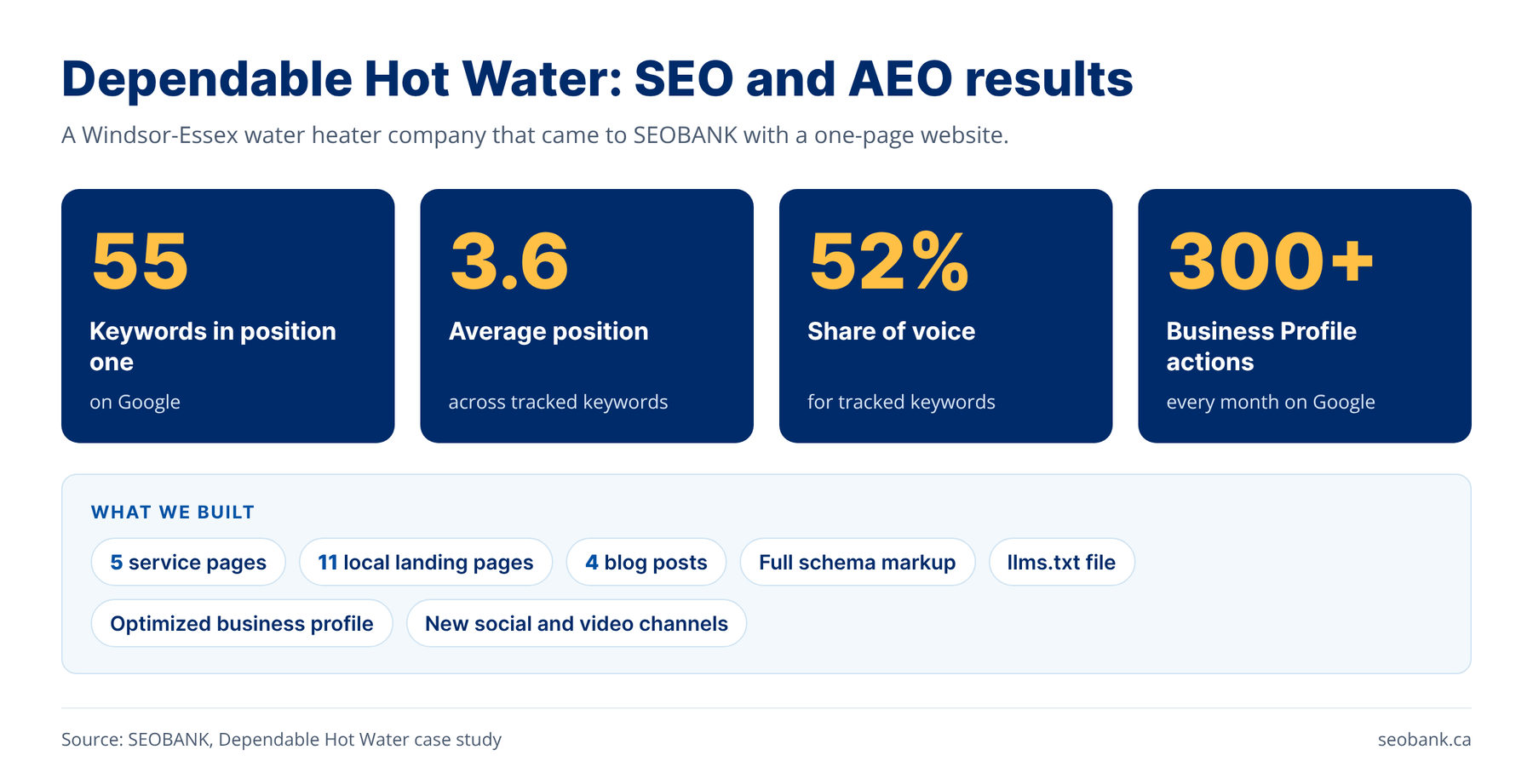
Dependable Hot Water, a Windsor-Essex water heater company, came to SEOBANK with a one-page website. We built five service pages, 11 local landing pages and four blog posts. We also added full schema markup and an llms.txt file, optimized the business profile and launched new social and video channels. The campaign reached 55 keywords in position one on Google, an average position of 3.6 across tracked keywords and a 52% share of voice, and the Google Business Profile generated more than 300 actions a month. Our case studies show the full plans and results.
Our digital marketing team serves businesses in Windsor, Essex County, Kingsville, Leamington, Chatham-Kent, London and Sarnia.
Rankings and AI citations now grow from the same work: clear pages, proof of expertise, consistent details and an active local presence. Contact SEOBANK Digital Marketing Agency today to build your plan for SEO and AEO 2026 and turn more searches into calls.